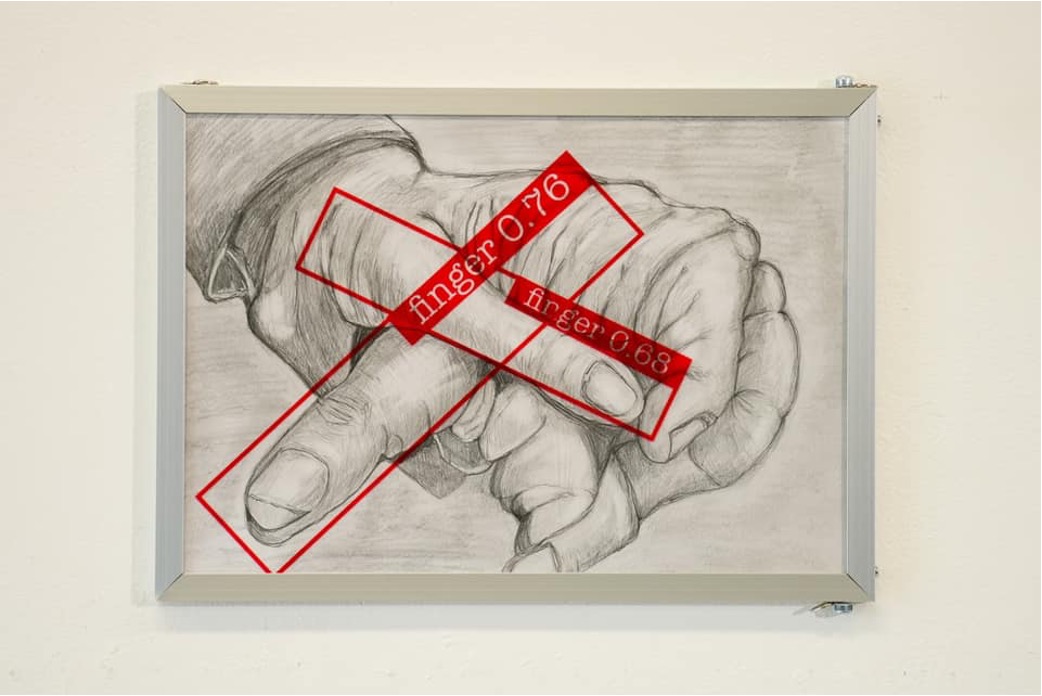
hand sketch, pencil drawing
When people generate images with AI, they often discard any picture in which the hand does not have exactly five fingers, treating it as junk. AI engineers likewise devote their coding skills—and vast amounts of GPU power and electricity—to the “evolutionary” task of teaching models to draw five perfect digits. In the shadow of that evolution, however, the everyday lives of people with three fingers or polydactyly are erased; minority bodies are quietly pushed aside.
This work begins by redrawing, in pencil, AI outputs that lack five fingers. With every stroke I imagine an actual person who lives that reality. I also built a custom AI recognition model focused on fingers; the regions it identifies as “finger” are enclosed in bounding boxes, and the confidence scores are printed on the glazing that overlays the drawing.
The AI expresses finger-likeness in clear numbers, but what, for us, constitutes a “proper” finger? Where does “normal” begin and end? What should we be teaching AI to call normal?
That question confronts not only AI developers but anyone who assumes they are untouched by the technology. Those who cannot answer may all be accomplices in this unacknowledged violence.